


This seminar will introduce initiatives to promote the transparency and mitigation effectiveness of climate change mitigation projects through the advancement of GOSAT satellite technology.
In Mongolia, a long-term mitigation project has begun to increase soil organic carbon through sustainable grassland management. Monitoring vast pastures using GOSAT is an advanced initiative that adds objective data to the project. In Central Asia, the Green Acceleration Centre has been established to promote investment in clean technologies across the region. The addition of the transparency provided by GOSAT is expected to significantly accelerate the greening of the entire region.
By promoting green technologies utilizing GOSAT, and by sharing efforts to introduce it into international standards and regional initiatives, it will deepen understanding of the importance of objective monitoring and verification, thereby enhancing the reliability and effectiveness of climate change countermeasures. Furthermore, stakeholders from various countries will collaborate to discuss specific actions for promoting greening in the future, aiming to accelerate regional and international cooperation.
Fri 14 Nov. 2025
Brazil time
11:45-13:00
Japan time
23:45-1:00
Innovation for Climate Mitigation Evaluation with GOSAT Satellite
Organizer : Ministry of the Environment, Japan・Ministry of Ecology and Natural Resources of the Republic of Kazakhstan・Ministry of Environment and Climate Change of Mongolia
Co-organizer : Chuo University, Japan・International Green Technologies and Investment Center, Kazakhstan・Information and Research Institute of Meteorology, Hydrology and Environment, Mongolia
Abstract
Program
Opening Remarks
NAMEKI Mimi|Director for International Cooperation for Transition to Decarbonization and Sustainable Infrastructure, MOEJ
Mansur Oshurbayev|Vice Minister of Ecology and Natural Resources of the Republic of Kazakhstan
ODKHUU Durzee|National Advisor on Climate Change to the Minister of Environment and Climate Change of Mongolia / National Focal Point of Mongolia for GCF
Keynote Speech: "Innovative GHG Estimation Technology with GOSAT Satellite for Transparent Evaluation of Climate Mitigation"
WATANABE Masataka|Institute Professor, Research and Development Initiative, Chuo University
Session "Challenging mitigation projects using GOSAT satellite"
Presentation 1: "The expected contribution of the GCF projects to the GHG reduction"
BATJARGAL Zamba|Focal point of the IPCC in Mongolia, Special Advisor to the IRIMHE
Presentation 2: "Activities in the field of GHG estimation and monitoring in Mongolia"
ENKHAMGALAN Tseelei|Senior Climate Change Officer, Climate Change and Sustainable Development Department, Asian Development Bank (ADB)
GERELMAA Shaariibuu|GHG Inventory Expert, Green Climate Cooperation, Mongolia
Presentation 3: “The Khurkh long-term ecological monitoring station in the Eastern grassland area of Mongolia, as the reference site for calibration of GOSAT and other satellite data”
NANDINTSETSEG Nyam-Osor|The Wildlife Science and Conservation Center
Session "Financing and Scaling Green Acceleration in Central Asia"
Presentation 1: "Green Acceleration in Central Asia: Proposal based on the experience of Kazakhstan"
Aidar Yessembayev|Head of Technologies Commercialization Competences Office, International Green Technologies and Investment Projects Center.
Presentation 2: "Scaling Up Clean Technology Innovation: The Role of International Cooperation and the GCIP Model (Tentative)"
Noelle O'Brien|Director of the Climate Change, Resilience, and Environment Cluster within the Climate Change and Sustainable Development Department, ADB
Presentation 3: "Financing Green Growth: The Importance of MRV and Innovation for Investment"
Kalyani Inampudi|International ESG and Carbon Consultant, the Republic of Kazakhstan
Wrap-up and Closing
WATANABE Masataka|Ditto
Session Summary
A seminar on climate mitigation using the GOSAT satellite was held at the Japan Pavilion during COP30, co-organized by Japan, Kazakhstan, and Mongolia. This hybrid seminar featured 12 speakers and over 25 on-site participants.
Discussions centered on international standardization of GHG emission estimation using GOSAT and green investment promotion in Central Asia and Mongolia. Japan proposed a ""hybrid methodology"" integrating bottom-up and satellite-based top-down approaches for IPCC guidelines. Mongolia reported on Green Climate Fund (GCF) projects targeting 112 million tCO₂e reductions with GOSAT-based MRV. Kazakhstan presented IGTIPC's green investment pipeline initiatives.
Participants agreed on three outcomes; necessity of the hybrid methodology, its demonstration through Mongolia's GCF FP154, and integration of satellite-based transparency into regional green investment. Results will be fed back into IPCC and UNFCCC discussions.
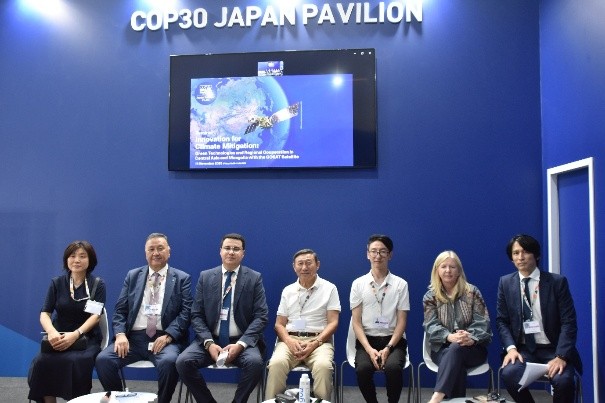
On-site Speakers
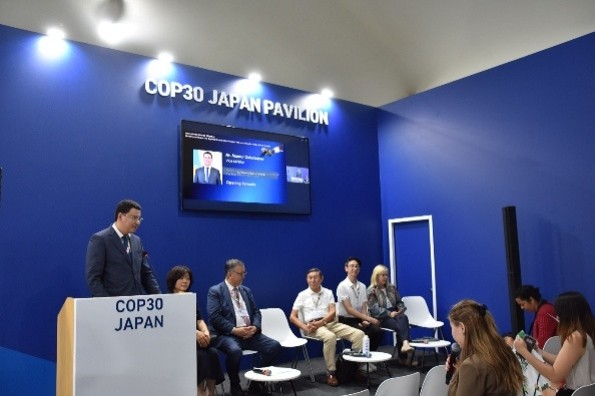
Opening Remarks by Vice Minister Mansur Oshurbayev
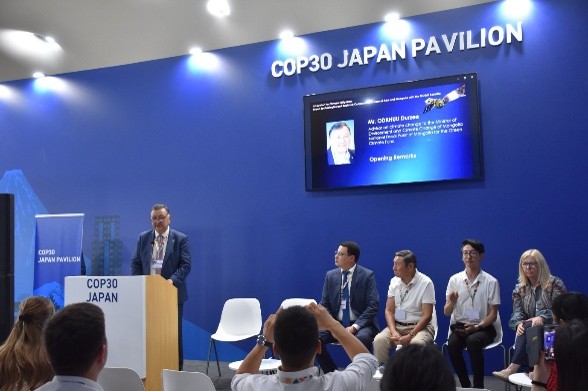
Mr. ODKHUU Durzee, Advisor to the Minister
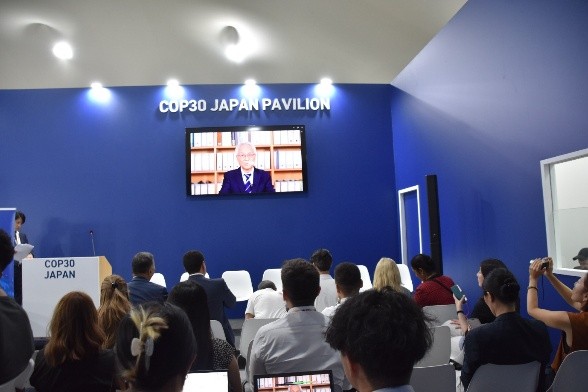
Keynote Presentation by Prof. WATANABE Masataka
